Category Archives: Glossary

masapan (glossary)

In the foreground, a plate of pistachio and lemon masapan. Photo © Janet Amateau.

In the foreground, a plate of pistachio and lemon masapan. Photo © Janet Amateau.

MASAPÁN (“mä-sä-PÄN) – To most people outside of Spain this is marzipan, but the similarity ends there.  Traditional Sephardic masapán is made from fresh, ground almonds (or a mixture of almonds plus other Mediterranean nuts), sugar and water, and may be scented with a few drops of rose water.  It is delicate in flavor, texture and color – neither gummy nor icky-sweet, and tinted only with the hues of its natural ingredients: creamy ivory from blanched almonds, delicate brown from hazelnuts, soft green from pistachios, pale yellow from lemons. 

Masapán is a compound word formed from “masa” (dough) and “pan” (bread).  The recipe contains no grain flour, however, for which it is presumed to have originated as a Passover confection.   Whether or not invented for that specific holiday, it is Jewish in origin and identified as such in documents from the Spanish Inquisition.

Masapán is still a prized confection in modern Spain, where it is a specialty of Toledo (a city of major importance in Sephardic history) and of various orders of nuns.
Leave a comment

Filed under Glossary, History, Holidays (fiestas judias)

Ojaldres (glossary)

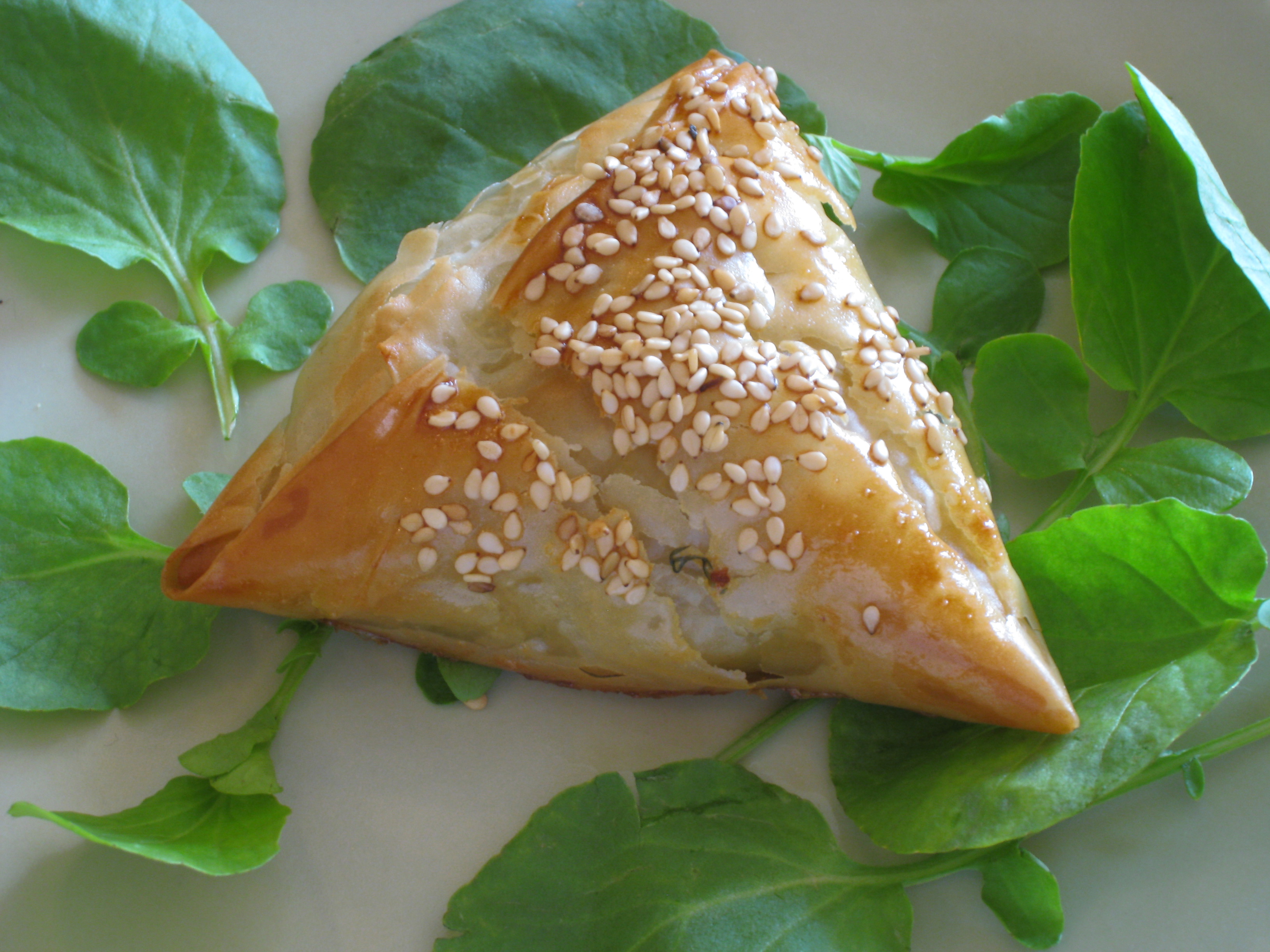
Ojaldre, the Ottoman-Sephardic savory pastry par excellence. © Janet Amateau.

Ojaldre, the Ottoman-Sephardic savory pastry par excellence. © Janet Amateau.

OJALDRES (“ōō- ZHÄL-dres”) – A specialty in the Ottoman-Sephardic tradition and particularly in Rhodes, these are small, triangular-shaped, savory pastries of a few layers of phyllo dough filled either with cheese and potato or ground beef and fresh herbs.   To make ojaldres is a labor of love and we generally reserve them for special occasions other than the major holidays, which have so many specific traditional foods associated with them. 

Hoja (oja in Ladino) and phyllo are the Spanish and Greek words, respectively, for leaf. As with the French mille feuilles (‘1,000 leaves,’ which in America is called a Napoleon), both describe  the distinctive characteristics of the pastry dough itself.

In modern Spanish, hojaldre (“ōHÄL-dre”) is the word for puff pastry. We tend to think of puff pastry as French, but the dough originated in Spain, where traditional bakeries make rustic puff pastries and cookies as they have for centuries. It’s also common to see the word applied to all variety of small sweet commericial cakes and cupcakes (think Hostess, Drake’s, Little Debbie).

6 Comments

Filed under Glossary

Cuajado (glossary)

CUAJADO (“kwä-ZHÄ-thō”)

Cuajado translates as either ‘coagulated’ or ‘having curds’ and describes any number of savory baked dishes made from a combination of mild, fresh curd cheese such as cottage or farmer, plus additional cheeses with varying degrees of saltiness, lots of eggs, a little matza meal for binding and copious amounts of one fresh, watery vegetable or another – spinach, zucchini, eggplant, leek or tomato.  Some recipes use bread as a binder and others mashed potato, depending on the vegetable used and your particular tradition or preference.  The texture is soft but not mushy, something like a savory bread pudding with the emphasis not on bread but on grated, shredded or mashed vegetables.  The cheese is used in a way that imparts flavor without dominating the texture.

Closely related to cuajado is fritada (fri-TÄ-tha), which translates as “a fried thing.”  It is no more than cuajado made on top of the stove in a skillet.  Fritada is very similar to Spanish tortilla (and Italian frittata) but unique in its inclusion of cheese.  It is the cheese, I believe, that marks these egg dishes as Jewish food; during the Inquisition, cuajado and fritada were already long considered as such and preparing or eating either one – especially if eaten on a Saturday – could have gotten you tossed into prison. 

Cuajado and fritada are indeed very typical Sephardic dishes for the Sabbath; they can be made ahead of time and taste best not hot but warm or at room temperature.

Cuajado is not to be confused with cuajada, which is a rennet custard traditionally made from ewe’s milk.

Leave a comment

Filed under Glossary, History

Cuajado (glosario)

Cuajado quiere decir tanto “coagulado” como “con grumos”, y describe infinidad de sabrosos platos hechos al horno, que combinan queso fresco suave (como queso cottage o queso de Burgos) con otros quesos más o menos salados, muchos huevos, un poco de matza molida o pan rallado para ligar la masa y cantidades copiosas de verduras frescas con alto contenido en agua – espinacas, calabacines, berenjenas, puerros o tomates. Algunas recetas usan pan para ligar la masa, y otras usan patatas, dependiendo de la verdura elegida y de la tradición particular o de la preferencia. La textura es suave pero no demasiado floja, algo así como un sabroso pudín de pan en el que resalta, no el pan, sino las verduras ralladas, cortadas a tiras o en puré. El queso se usa de forma que confiera sabor sin dominar en la textura.

Muy relacionada con el cuajado está la fritada, que quiere decir “algo frito”. No se trata más que de un cuajado hecho al fuego en una sartén. La fritada se parece mucho a la tortilla española (y a la italiana frittata), pero es la única que incluye el queso. Es el queso, creo yo, lo que distingue a estos platos con huevo como comida judía: durante la época de la Inquisición, el cuajado y la fritada ya eran considerados como tales, y prepararlos o comerlos – sobretodo en sábado – te podía mandar a prisión.

Cuajado y fritada son, de hecho, platos sefardíes muy típicos de Shabat; se pueden preparar con antelación y saben mejor si, en vez de calientes, se sirven templados o a temperatura ambiente.

El cuajado no debe ser confundido con la cuajada, que es un requesón hecho con cuajo y, tradicionalmente, leche de oveja.

Leave a comment

Filed under Escrito en castellano, Glossary, History