Category Archives: Holidays (fiestas judias)

Mina


MINA (“MI-nä”) is an Ottoman Sephardic savory pie made from ground beef, onion and spring herbs, bound with eggs and sandwiched between layers of matza (moistened, of course).  In my experience it is a specialty of Rhodes, where it is a star of the Passover repertoire.  However, it is nearly identical to Algerian Sephardic méguena in all except its use of matza, which the Algerian recipe dispenses with altogether in the versions I am familiar with. (Algeria was part of the Ottoman Empire from 1536 to 1830 and had a substantial Jewish community).

There are vegetable minas as well; however, mina is not simply another kind of cuajado.  A true mina contains no cheese, and eggs serve to bind the filling without dominating its appearance or texture. 

As with mustachudos, mina offers another fine example of how symbolism is incorporated into Sephardic recipes, in this case repeating elements of the Seder plate: parsley and eggs to represent springtime and renewal and matza, of course, the unleavened bread of the Exodus that is eaten throughout the week-long holiday.  Mina is served cut in large squares, which bring to my mind the bricks of the Egyptian pyramids – in shape only, as a well-made mina is delicate, moist and intoxicatingly delicious!
 

Leave a comment

Filed under Glossary, Holidays (fiestas judias)

Mustachudos

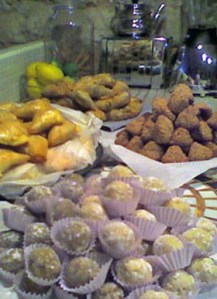
masapan_-ojaldres_-mustachudos1MUSTACHUDOS  (“mōō-stä-CHŌŌ-thōs”)  Here is a prime example of the way in which many Sephardic foods are infused with symbolism.

As a general rule, Sephardic custom doesn’t call much for cooking with wine. There are exceptions, of course, and these can be unusual enough as to impact the name of the recipe in question.  During Passover, any wine consumed must be ‘new’; this means using either grape juice or young wine that is kosher for Passover.  The mustachudo gets its name from this specific ingredient:  musto in Ladino; mosto in Spanish and Italian, must in English. The name has absolutely nothing to do with ‘little moustaches’, despite the similar-sounding root word. Continue reading

2 Comments

Filed under Glossary, Holidays (fiestas judias)

Cuajado

CUAJADO (“cua-XA-do”) quiere decir tanto “coagulado” como “con grumos”, y describe una clase de sabrosos platos hechos al horno, que combinan queso fresco suave (como queso cottage o queso de Burgos) con otros quesos más o menos salados, muchos huevos, un poco de harina de matza (pan ácimo) para ligar la masa y cantidades copiosas de verduras frescas con alto contenido en agua: espinacas; calabacines; berenjenas; puerros; o tomates. Algunas recetas usan pan para ligar la masa y otras usan patatas, dependiendo de la verdura elegida y de la tradición particular o de la preferencia personal. La textura es suave pero no demasiado floja, algo así como un sabroso pudín de pan en el que resalta, no el pan, sino las verduras ralladas, cortadas a tiras o machacadas. El queso se usa de forma que confiera sabor sin dominar en la textura. Continue reading

Leave a comment

Filed under Escrito en castellano, Glossary, History, Holidays (fiestas judias)

Ouevos Haminados

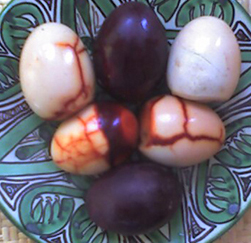
GUEVOS HAMINADOS   (“GWEH-vos hä-mi-NÄthos”)  – The word ham in hebrew means “warm”; haminado is a Ladino adjective meaning “warmed.”  Far from ordinary, these “warmed eggs” acquire a velvety texture and an intoxicating, smoky onion flavor from a six-hour bath in warm water and onion skins – slow cooking really does make a difference.  Besides lending their marvelous flavor, onion skins also act as a natural dye.  If the eggshells remain intact, the eggs turn a delicate shade of light brown, like a very pale cup of coffee, and when cracked they take on a striking range of deep reds and unique patterns that suggest marble.  It’s a fairly safe bet that the inspiration for dyed Easter eggs began with this custom.

Guevos haminados are one of many Jewish foods that pre-date the Inquisition.  Although eggs were commonplace in all cuisines of Medieval Europe, it was well known in Spain that slow-braising whole eggs was a technique unique to the Jews.  More than a few conversos were imprisoned or sentenced to death on the basis of their having continued to eat ouevos haminados.  500 years after the expulsion, eggs in general remain an important component of the Ottoman-Sephardic diet (and, I should add, the Spanish diet as well).

Guevos haminados are generally most associated with the Sabbath desayuno (breakfast) and with Passover, when they appear on the Seder plate, but they are a fundamental element of Ottoman-Sephardic cuisine, eaten on their own or incorporated into other dishes – for example, baked into a meatloaf (without the shell, of course).

11 Comments

Filed under Glossary, History, Holidays (fiestas judias)