Category Archives: History

Ashkenazi Mina, Anyone?

Dear Janet,

My grandparents Nissim, and Virginia, originally came from Istanbul, and the area in Bulgaria just over the Turkish border. I grew up eating borekas, spinach pies, haviar (tarama), biscochos, et al. But there is one dish my grandmother made that although I’ve researched everywhere haven’t found anything remotely similar. Unfortunately no one’s left alive who can even remember what it was called. The ingredients were ground liver, raw eggs, chopped walnuts, rye bread, and possibly chopped onions/celery. The raw ingredients were combined making a paste, which was then spread into a greased baking pan about 1/2 an inch thick, the top glazed with beaten egg, and baked. When cut and served it was quite firm, and dark brown on top. Have you ever heard of anything similar?

Thanks so much for all your hard work, it’s been an enjoyable read.

Alan

Wow.  When we talk about Jewish cooking being adaptive, I suspect this may be a prime – and very personal – example.  Off the top of my head, this sounds like a Sephardic rendition of a classic Ashkenazi dish from Eastern Europe:  chopped chicken liver.  Neither rye bread nor chopped chicken liver are part of Sephardic gastronomy.  Continue reading
5 Comments

Filed under History, Holidays (fiestas judias), Your Questions Answered

Survival of the Fittest / La Ley de Supervivencia (Q & A)

Queridos lectores, he recibido el siguiente mensaje en castellano y por eso yo queria presentar mi respuesta – este articulo –  en castellano antes que en ingles, pero ningun de mis traductores estan disponibles y escribo muy, muy despacio (y mal) en castellano.  Por eso, os presento todo en ingles y apenas posible la traduccion (y con accentos!) — JA

Hola Janet,  es un placer haber encontrado tu Blog, estoy estudiando cocina en París, y realmente me gustaría aprender y conocer mas sobre la cocina Sefardí y como, no solo ha sobrevivido durante siglos, sino que hoy día es una realidad.
Una cosa muy graciosa es que, en mi casa estamos bien familiarizado con el cuajao, pero en este caso es de pescado, mi Abuela Petra todavía lo cocina.
mil gracias y felicitaciones por tu trabajo
Nerwin

Hi, Janet. 

It’s a pleasure to have found your blog.  I’m studying cooking in Paris, and I really would like to learn and know more about Sephardic cooking and how it has not only survived for centuries, but today is a reality.   A funny thing is that in my house we’re very familiar with cuajado, but in this case it’s made with fish; my Grandmother Petra still makes it. 

A thousand thanks and congratulations on your work.


Nerwin

 Dear Nerwin, 

Many thanks for your kind words and for asking such a good question.  I thought the best way to answer you would be with a brief lesson in Sephardic history (which makes for a long blog entry). 


Really there is no mystery at all as to how Sephardic cuisine has survived over the centuries – especially if you’re Sephardic.  To begin to understand, you need to know Continue reading

1 Comment

Filed under Escrito en castellano, History, Other Reading, Your Questions Answered

Cuajado

CUAJADO (“cua-XA-do”) quiere decir tanto “coagulado” como “con grumos”, y describe una clase de sabrosos platos hechos al horno, que combinan queso fresco suave (como queso cottage o queso de Burgos) con otros quesos más o menos salados, muchos huevos, un poco de harina de matza (pan ácimo) para ligar la masa y cantidades copiosas de verduras frescas con alto contenido en agua: espinacas; calabacines; berenjenas; puerros; o tomates. Algunas recetas usan pan para ligar la masa y otras usan patatas, dependiendo de la verdura elegida y de la tradición particular o de la preferencia personal. La textura es suave pero no demasiado floja, algo así como un sabroso pudín de pan en el que resalta, no el pan, sino las verduras ralladas, cortadas a tiras o machacadas. El queso se usa de forma que confiera sabor sin dominar en la textura. Continue reading

Leave a comment

Filed under Escrito en castellano, Glossary, History, Holidays (fiestas judias)

Ouevos Haminados

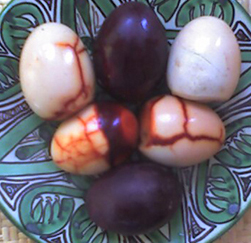
GUEVOS HAMINADOS   (“GWEH-vos hä-mi-NÄthos”)  – The word ham in hebrew means “warm”; haminado is a Ladino adjective meaning “warmed.”  Far from ordinary, these “warmed eggs” acquire a velvety texture and an intoxicating, smoky onion flavor from a six-hour bath in warm water and onion skins – slow cooking really does make a difference.  Besides lending their marvelous flavor, onion skins also act as a natural dye.  If the eggshells remain intact, the eggs turn a delicate shade of light brown, like a very pale cup of coffee, and when cracked they take on a striking range of deep reds and unique patterns that suggest marble.  It’s a fairly safe bet that the inspiration for dyed Easter eggs began with this custom.

Guevos haminados are one of many Jewish foods that pre-date the Inquisition.  Although eggs were commonplace in all cuisines of Medieval Europe, it was well known in Spain that slow-braising whole eggs was a technique unique to the Jews.  More than a few conversos were imprisoned or sentenced to death on the basis of their having continued to eat ouevos haminados.  500 years after the expulsion, eggs in general remain an important component of the Ottoman-Sephardic diet (and, I should add, the Spanish diet as well).

Guevos haminados are generally most associated with the Sabbath desayuno (breakfast) and with Passover, when they appear on the Seder plate, but they are a fundamental element of Ottoman-Sephardic cuisine, eaten on their own or incorporated into other dishes – for example, baked into a meatloaf (without the shell, of course).

11 Comments

Filed under Glossary, History, Holidays (fiestas judias)