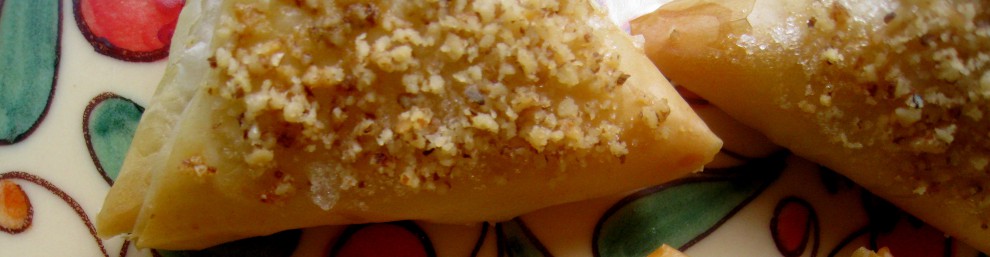
CUAJADO (“cua-XA-do”) quiere decir tanto “coagulado” como “con grumos”, y describe una clase de sabrosos platos hechos al horno, que combinan queso fresco suave (como queso cottage o queso de Burgos) con otros quesos más o menos salados, muchos huevos, un poco de harina de matza (pan ácimo) para ligar la masa y cantidades copiosas de verduras frescas con alto contenido en agua: espinacas; calabacines; berenjenas; puerros; o tomates. Algunas recetas usan pan para ligar la masa y otras usan patatas, dependiendo de la verdura elegida y de la tradición particular o de la preferencia personal. La textura es suave pero no demasiado floja, algo así como un sabroso pudín de pan en el que resalta, no el pan, sino las verduras ralladas, cortadas a tiras o machacadas. El queso se usa de forma que confiera sabor sin dominar en la textura. Continue reading
Category Archives: Glossary
Ouevos Haminados
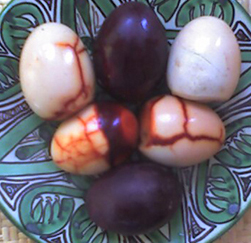 GUEVOS HAMINADOS (“GWEH-vos hä-mi-NÄ–thos”) – The word ham in hebrew means “warm”; haminado is a Ladino adjective meaning “warmed.” Far from ordinary, these “warmed eggs” acquire a velvety texture and an intoxicating, smoky onion flavor from a six-hour bath in warm water and onion skins – slow cooking really does make a difference. Besides lending their marvelous flavor, onion skins also act as a natural dye. If the eggshells remain intact, the eggs turn a delicate shade of light brown, like a very pale cup of coffee, and when cracked they take on a striking range of deep reds and unique patterns that suggest marble. It’s a fairly safe bet that the inspiration for dyed Easter eggs began with this custom.
Guevos haminados are one of many Jewish foods that pre-date the Inquisition. Although eggs were commonplace in all cuisines of Medieval Europe, it was well known in Spain that slow-braising whole eggs was a technique unique to the Jews. More than a few conversos were imprisoned or sentenced to death on the basis of their having continued to eat ouevos haminados. 500 years after the expulsion, eggs in general remain an important component of the Ottoman-Sephardic diet (and, I should add, the Spanish diet as well).
Guevos haminados are generally most associated with the Sabbath desayuno (breakfast) and with Passover, when they appear on the Seder plate, but they are a fundamental element of Ottoman-Sephardic cuisine, eaten on their own or incorporated into other dishes – for example, baked into a meatloaf (without the shell, of course).
Filed under Glossary, History, Holidays (fiestas judias)
Boyos / Bollos (glossary)
Okay, this is it. I’ve revised the glossary entry based on my new and improved understanding of boyos. This replaces my post of January 7, which you won’t find any more.
BOYO (BOY-ōō) is the Ladino word for bun – spelled bollo in modern Spanish. In Sephardic cookery it is a generic term applied to a broad range of savory & sweet baked goods, be they doughy, crunchy, chewy, flaky and so forth. Some examples include boyos de vino (biscocho cookies made with wine); boyos de rayo (flaky cheese biscuits) and just plain boyos, which are savory pastries filled with spinach, or cheese, or spinach & cheese (yes, there are more kinds of boyos).
Boyiko is the diminutive of boyo. The literal translation is ‘small boyo’, but it can just as easily imply ‘without filling.’ Either way it signifies an abbreviated form of boyo.
It’s the use of the word ‘bun’ that has intrigued me, since cookies (boyos de vino) and biscuits (boyos de rayo) are not buns, obviously. To understand why these, too, would fall under the bun category, I looked to the word itself and to technique for an explanation. And therein lay the answer.
All of these wildly different boyos share a specific technique when made according to tradition. After a pastry is first either folded and filled or rolled into a small ball, it is then mashed down lightly with the heel of the hand prior to baking, forming a small cavity or dent. It is the dent itself that turns out to be the origin of the pastry name, as the word ‘bollo’ has a second meaning: dent. In Spain today (if not elsewhere in the Spanish-speaking world), this usage is more colloquial, having been replaced by the more lofty-sounding ‘abollatura’.
The dent serves a purpose. In the case of non-filled boyos or boyikos, it is a quick and effective means of making a reasonably flat cookie without a rolling pin, and in the case of filled boyos, pressing the dough seals the pastry shut. It’s that simple. You want to make boyos of any kind? Flatten them with your hand before you bake them. I’m retiring my rolling pin.
My thanks to Michael, Zoe and my Aunt Rady, whose recollections of hand-pressing the dough of three radically different pastries helped me get to the bottom of boyos! There’s much, much more to say on the subject, but I’ll leave that for another day.
You have no idea how much I love this work.
Filed under Glossary
More on Boyos: a revised conclusion / Mas Sobre Boyos
Your participation is not only encouraging but proving to be very, very helpful; it is our collective personal experience that leads me toward what I believe are the right conclusions for so many unanswered questions about Sephardic food.
Recently, for example, I’ve been wondering why there are so many variations of boyos that, apart from the name ‘boyo’, seem to bear no resemblance whatsoever to one another. Why on Earth would cookies and biscuits be categorized as buns (which is what ‘boyo’ means)? I did draw one conclusion, based on how recipes evolve, which I included in the glossary (read that post here). But that conclusion, for all its logic, didn’t quite satisfy me. Thanks to your participation, I now know why: The common denominator is one of technique. Continue reading
Filed under Glossary

 SEPHARDIC FOOD