Tag Archives: Ottoman

Cuajado (glossary)

CUAJADO (“kwä-ZHÄ-thō”)

Cuajado translates as either ‘coagulated’ or ‘having curds’ and describes any number of savory baked dishes made from a combination of mild, fresh curd cheese such as cottage or farmer, plus additional cheeses with varying degrees of saltiness, lots of eggs, a little matza meal for binding and copious amounts of one fresh, watery vegetable or another – spinach, zucchini, eggplant, leek or tomato.  Some recipes use bread as a binder and others mashed potato, depending on the vegetable used and your particular tradition or preference.  The texture is soft but not mushy, something like a savory bread pudding with the emphasis not on bread but on grated, shredded or mashed vegetables.  The cheese is used in a way that imparts flavor without dominating the texture.

Closely related to cuajado is fritada (fri-TÄ-tha), which translates as “a fried thing.”  It is no more than cuajado made on top of the stove in a skillet.  Fritada is very similar to Spanish tortilla (and Italian frittata) but unique in its inclusion of cheese.  It is the cheese, I believe, that marks these egg dishes as Jewish food; during the Inquisition, cuajado and fritada were already long considered as such and preparing or eating either one – especially if eaten on a Saturday – could have gotten you tossed into prison. 

Cuajado and fritada are indeed very typical Sephardic dishes for the Sabbath; they can be made ahead of time and taste best not hot but warm or at room temperature.

Cuajado is not to be confused with cuajada, which is a rennet custard traditionally made from ewe’s milk.
Leave a comment

Filed under Glossary, History

BISCOCHOS (glossary)

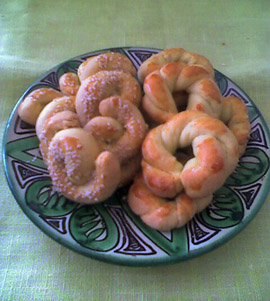
Rhodes-style biscochos and reshas on traditional Jewish pottery from Teruel (Aragon). Photo © Janet Amateau.

Rhodes-style biscochos and reshas on traditional Jewish pottery from Teruel (Aragon). Photo © Janet Amateau.

BISCOCHO (“bis-KŌ-ch ōō”)  – like the French biscuit and Italian biscotto– literally means “twice cooked.” A biscocho is a firm, not-too-sweet, shortbread cookie that is baked once and then re-baked for crisping.  Oil gives the dough great elasticity, making it easy to work into different shapes, and the name changes according to variations in shape and flavorings.  Rhodesli reshas, for example, also called reshikas, are biscocho dough that is twisted into a pretzel-like coil and topped with sesame seeds.

The basic biscocho recipe calls for orange juice as the flavoring – a reflection of tastes developed in Spain – and changes according to the whims of the baker, who might also use cinnamon, anise and/or a liqueur or brandy for additional flavoring.

Biscochos are a staple in Ottoman Sephardic homes.  Ideal with coffee, tea or a glass of milk, they’re the kind of treat you keep on hand for snacks or impromptu visits.

In modern Spanish culture, bizcocho refers to basic yellow cake made with shortening.

13 Comments

Filed under Glossary

A little Hanukah history, and a little recipe. Or two.

Okay, so here’s the story of Hanukah in a nutshell:  Political infighting between three guys vying for the High Priest spot in Judea resulted in the murder of one of them, and in seriously pissing off their Syrian ruler, Antiochus, because the murdered guy was his pick for the top spot. So Antiochus got mad at all the Jews because of these infighting knuckleheads, shut their Temple down and forbid anyone from practicing Judaism anymore. If you want a time frame, we’re talking the 2nd century BCE. Eventually, Judah Maccabee, the son of a Jewish dissident priest who was hellbent on regaining religious freedom, formed a guerilla army that successfully ousted Antiochus. With Jerusalem now reclaimed, the Jews could reconsecrate their Temple and start worshipping there again.

If you’re unfamiliar with Jewish synagogues then you don’t know that they always contain a light called the Ner Tamid – Eternal Flame – that burns continually as a reminder of the eternal presence of God. In my lifetime I’ve only ever seen the eternal lightbulb, but 2,200 years or so before Thomas Edison, you can be sure oil lamps were de rigeur.    Continue reading

17 Comments

Filed under History, Holidays (fiestas judias), Recipes