Category Archives: Recipes

Dulce lo vivas – May you live sweetly!

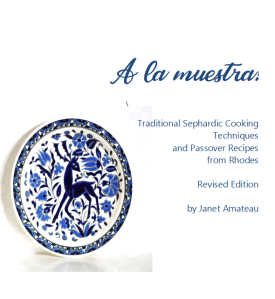
Dulce lo vivas – la reposteria sefardi by Ana Bensadón (Ediciones Martinez-Roca, Madrid, 2006)

There are many wonderful Sephardic cookbooks – actually written by Sephardim, for a change – that for whatever reason are not available in English. This is a shame, but I suspect that with the growing mania for all things Sephardic, it won’t be long before a publisher or two snap up some rights and get busy translating. They should.

I came across this book one day in the spring of 2006, in a tea salon in Barcelona’s Barri Gotic (Gothic quarter). Small and unassuming, it caught my eye – a straightforward recipe book with no drawings, very few photographs, and the briefest of introductions.  Most of the recipes bore little semblance to the sweets and baked goods I knew from my family’s Ottoman tradition, but there was an approach, a style – delicate, at once elegant and simple – that was undeniably Sephardic. I flipped.
Continue reading

4 Comments

Filed under Other Reading, Recipes

Ajada (Q & A and a recipe)

Hi Janet,

My mother used to make what we called Ajada. It was made with soaked bread, eggs, fresh garlic and lemon juice. It was mixed and mashed together and we used it as a dip for meat. What is the origin of this food?   Is it Turkish or Spanish or Greek?  I would love a recipe if one is available.  Did I ask this question before?  Thanks and wish I could come and take a class with you.

Estelle

Good question, Estelle.

Ajada, a traditional Sephardic condiment, has its roots right here where I live in the north western Mediterranean and is just one member of a broad category of emulsions that are used at table to flavor savory meals – meats, fish, soups, stews, vegetables, you name it.  The word ajada is Ladino and translates loosely as ‘a thing made of/with garlic’ which, along with olive oil, is the basic recipe for the whole category.  Between Catalan, Spanish, French, Langue d’Òc, Italian and umpteen different dialects of each, garlic & oil emulsion goes by at least a dozen different spellings, among them alioli, aioli, alhòli, alloli, ajjoli, aillade, and ajada. The French word in the group, aillade, is equivalent in structure to the Ladino ajada.  The others you see here are all compound words, in various Romance languages, that mean garlic (allium – of the onion family) and oil (oleum).   And with this many variations in the spelling alone, you can easily imagine the countless variations in the recipe – Continue reading

14 Comments

Filed under Glossary, Recipes, Your Questions Answered

Conversion chart (weights & measures) / Conversiones (pesos y medidas)

Un lector me ha pedido explicar las medidas estadounidenses.  En los Estados Unidos, en la casa generalmente se usa medidas de volumen para cualquier cosa que se puede verter o poner facilmente dentro una ‘taza’, incluido solidos – por ejemplo: harina, azucar, arroz, frutos secos y datiles triturados.  Aquellos de volumen seco hay en medidas de 1 cup (tazo), 1/2 cup, 1/3 cup, 1/4 cup y 1/8 cup.  Para cantidades mas pequeñas usamos el Tablespoon (cucharada ‘de mesa’ o sopera), el teaspoon (cuchara de te), y fracciones del teaspoon.  Abajo os doy Continue reading

1 Comment

Filed under Escrito en castellano, Recipes

Spinach Cuajado / Cuajado de Espinaca

We’re deep into summer now, and one of the nicest things to eat on a lazy summer day is cuajado and a fresh salad. There’s no need for a big spread every time you make a cuajado, as it’s quite filling on its own.

When my grandma and great aunt Reina were alive, we ate a lot of spinach cuajado (as opposed to my favorite, zucchini). When I was very young, the aroma of spinach & all those cheeses cheese baking in the oven was too intense for my sensitive little nose (which is no longer quite so sensitive nor, alas, quite so little).  But once out of the oven, the flavors mellowed and I couldn’t get enough.  Because spinach itself has a more intense flavor than zucchini,  this cuajado needs a stronger cheese, too: pecorino romano instead of parmiggiano, which works perfectly with zucchini but would be too delicate here.

So here’s my recipe for the spinach, also adapted from my Aunt Reina’s.  The sesame seeds aren’t traditional, though I wonder why. They are well within the bounds of tradition and a nice finishing touch with the spinach.

recipe

11 Comments

Filed under Recipes