masapan (glossary)

In the foreground, a plate of pistachio and lemon masapan. Photo © Janet Amateau.

In the foreground, a plate of pistachio and lemon masapan. Photo © Janet Amateau.

MASAPÁN (“mä-sä-PÄN) – To most people outside of Spain this is marzipan, but the similarity ends there.  Traditional Sephardic masapán is made from fresh, ground almonds (or a mixture of almonds plus other Mediterranean nuts), sugar and water, and may be scented with a few drops of rose water.  It is delicate in flavor, texture and color – neither gummy nor icky-sweet, and tinted only with the hues of its natural ingredients: creamy ivory from blanched almonds, delicate brown from hazelnuts, soft green from pistachios, pale yellow from lemons. 

Masapán is a compound word formed from “masa” (dough) and “pan” (bread).  The recipe contains no grain flour, however, for which it is presumed to have originated as a Passover confection.   Whether or not invented for that specific holiday, it is Jewish in origin and identified as such in documents from the Spanish Inquisition.

Masapán is still a prized confection in modern Spain, where it is a specialty of Toledo (a city of major importance in Sephardic history) and of various orders of nuns.

Leave a comment

Filed under Glossary, History, Holidays (fiestas judias)

Dondurma: Turkish orchid ice cream / Helado turco de orquideas (Q & A)


My mother used to refer to an ice cream she called Dondurma. Are you familiar with this?  Have you ever made it.  Once, when I was a small child my mother took me somewhere in Brooklyn to eat some and it was divine.  My mother was from Monastir, now known as Bitol.  Our food were greatly influenced by the Turkish.   — healthgal

Well, healthgal, this is a good example of a food that isn’t Sephardic per se but which, as a Turkish delicacy, was – is – consumed by Sephardim along with everyone else in that part of the world.  Your mother’s city was within the Ottoman Empire, thus the Turkish influence on her food.  Manastir, today called Bitola, is a city in southern Macedonia that lies roughly mid-way between Puglia (the southeastern spur of Italy) and Salonika.

Dondurma (don-DŌŌR-mä), is simply the Turkish word for ice cream, although the similarity pretty much ends there.  Elastic, dense and slow to melt, dondurma is made from a mixture of milk, mastic resin and salep.  Mastic is an ancient Mediterranean evergreen in the pistachio family and salep is a flour made from Turkish wild orchid tubers of the same name.  Salep Dondurma – orchid ice cream – is only about 300 years old; the conventional wisdom is that it was invented in a part of southeastern Turkey where all three key ingredients were plentiful.  Dondurma is made by beating the ingredients into a smooth, elastic mass using a long metal rod.  Fresh dondurma is draped on large hooks and dense enough to eat with a knife and fork.  It is eaten cold, but not frozen.  Unlike other ice creams, if allowed to freeze it turns rock hard and brittle.  Today, it is impossible to make dondurma outside of Turkey; mass production has so seriously depeleted Turkey’s supply of wild orchids that there’s a government ban on their exportation.

While investigating dondurma it struck me that the texture, if not the temperature, might be reminiscent of Bonomo’s Turkish Taffy, a favorite candy of my childhood.  Lo and behold,  the Bonomo Candy Company was founded in Coney Island in 1897 by one Albert J. Bonomo (Benhamou, I presume), a Sephardic immigrant from Turkey.  Apparently, the Bonomos of Brooklyn loved dondurma as much as your mother did, or at the very least understood its appeal; it was Albert’s son, Victor, who invented “Turkish Taffy” in the 1940’s.  How do you like that.
4 Comments

Filed under History, Your Questions Answered

Ojaldres (glossary)

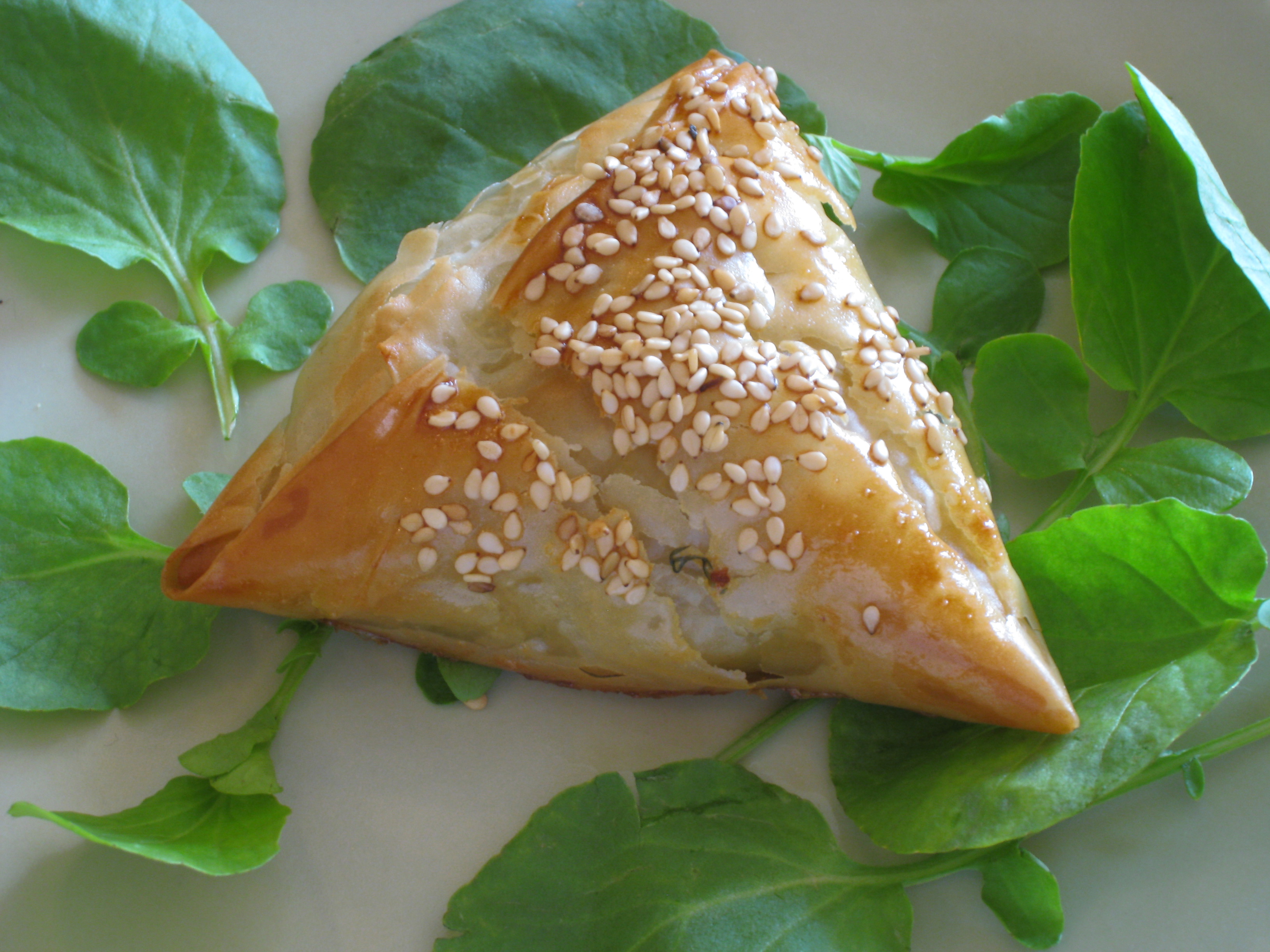
Ojaldre, the Ottoman-Sephardic savory pastry par excellence. © Janet Amateau.

Ojaldre, the Ottoman-Sephardic savory pastry par excellence. © Janet Amateau.

OJALDRES (“ōō- ZHÄL-dres”) – A specialty in the Ottoman-Sephardic tradition and particularly in Rhodes, these are small, triangular-shaped, savory pastries of a few layers of phyllo dough filled either with cheese and potato or ground beef and fresh herbs.   To make ojaldres is a labor of love and we generally reserve them for special occasions other than the major holidays, which have so many specific traditional foods associated with them. 

Hoja (oja in Ladino) and phyllo are the Spanish and Greek words, respectively, for leaf. As with the French mille feuilles (‘1,000 leaves,’ which in America is called a Napoleon), both describe  the distinctive characteristics of the pastry dough itself.

In modern Spanish, hojaldre (“ōHÄL-dre”) is the word for puff pastry. We tend to think of puff pastry as French, but the dough originated in Spain, where traditional bakeries make rustic puff pastries and cookies as they have for centuries. It’s also common to see the word applied to all variety of small sweet commericial cakes and cupcakes (think Hostess, Drake’s, Little Debbie).

6 Comments

Filed under Glossary

Cuajado (glossary)

CUAJADO (“kwä-ZHÄ-thō”)

Cuajado translates as either ‘coagulated’ or ‘having curds’ and describes any number of savory baked dishes made from a combination of mild, fresh curd cheese such as cottage or farmer, plus additional cheeses with varying degrees of saltiness, lots of eggs, a little matza meal for binding and copious amounts of one fresh, watery vegetable or another – spinach, zucchini, eggplant, leek or tomato.  Some recipes use bread as a binder and others mashed potato, depending on the vegetable used and your particular tradition or preference.  The texture is soft but not mushy, something like a savory bread pudding with the emphasis not on bread but on grated, shredded or mashed vegetables.  The cheese is used in a way that imparts flavor without dominating the texture.

Closely related to cuajado is fritada (fri-TÄ-tha), which translates as “a fried thing.”  It is no more than cuajado made on top of the stove in a skillet.  Fritada is very similar to Spanish tortilla (and Italian frittata) but unique in its inclusion of cheese.  It is the cheese, I believe, that marks these egg dishes as Jewish food; during the Inquisition, cuajado and fritada were already long considered as such and preparing or eating either one – especially if eaten on a Saturday – could have gotten you tossed into prison. 

Cuajado and fritada are indeed very typical Sephardic dishes for the Sabbath; they can be made ahead of time and taste best not hot but warm or at room temperature.

Cuajado is not to be confused with cuajada, which is a rennet custard traditionally made from ewe’s milk.

Leave a comment

Filed under Glossary, History