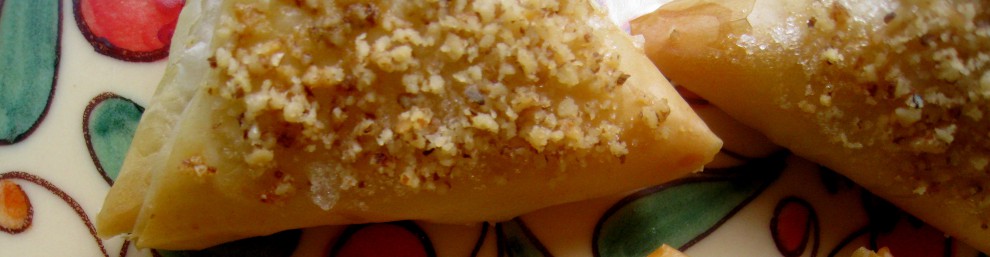
PEPITADA (“peh-pi-TAH-dtha”) is a Ladino word indicating a beverage ‘made from fruit pip (seeds)’. The “-ada” suffix is the equivalant of “-ade” in English, as in lemonade. Pepitada is a milky-looking drink made by steeping crushed melon seeds in cold water, straining them and adding a little sugar and perhaps a few drops of orange flower essence, rosewater or honey (the secondary flavorings vary regionally throughout the Mediterranean). You think the makers of Gatorade were innovators? Pepitada is a straightforward health tonic: easy on the stomach, refreshing and loaded with potassium, it replenishes electrolytes. Pepitada is mostly associated with breaking fasts (perhaps especially the fast of Tisha b’Av, which falls in summer smack in the the middle of melon season) but is also an excellent means of coping with the intense heat of deep summer.
Spinach Cuajado / Cuajado de Espinaca
We’re deep into summer now, and one of the nicest things to eat on a lazy summer day is cuajado and a fresh salad. There’s no need for a big spread every time you make a cuajado, as it’s quite filling on its own.
When my grandma and great aunt Reina were alive, we ate a lot of spinach cuajado (as opposed to my favorite, zucchini). When I was very young, the aroma of spinach & all those cheeses cheese baking in the oven was too intense for my sensitive little nose (which is no longer quite so sensitive nor, alas, quite so little). But once out of the oven, the flavors mellowed and I couldn’t get enough. Because spinach itself has a more intense flavor than zucchini, this cuajado needs a stronger cheese, too: pecorino romano instead of parmiggiano, which works perfectly with zucchini but would be too delicate here.
So here’s my recipe for the spinach, also adapted from my Aunt Reina’s. The sesame seeds aren’t traditional, though I wonder why. They are well within the bounds of tradition and a nice finishing touch with the spinach.
Filed under Recipes
A grain by any other name: more about Kolva
I’ve mentioned before how recipe names morph, which can make research tricky. Early in April, in response to a question submitted here, I wrote about a wheat pudding called colva or kolva. The one reliable reference I had found was a 1922 survey on nutrition, thoroughly secular and with no discussion whatsoever of religion or culture. I presented the recipe here – I couldn’t dig deeper at the time – and that was that. But I wasn’t satisfied.
And with good reason, as it turns out. A little more work on the name and I got to the root of near-eastern wheat puddings: colva… kolva… kholva… khalva… halva. Halva! Of course. But halva is just sweet sesame paste, right? Nope. According to Wikipedia, ‘halva’ (or halvah or halavah or halweh, etc.) is the Arabic root word for ‘sweet’, period. Candy. And as a generic it applies to a huge range of grain-based sweet confections “across the Middle East, Central Asia, South Asia, the Balkans and the Jewish World.” Who knew?
In my house (in America) halva was just one thing – crumbly, bittersweet sesame paste candy – but halvas turn out also to be made from semolina, bulgur, sunflower seeds, carrots, even gourds, and often with the addition of pistachios, almonds, walnuts or peanuts. Continue reading
Filed under Holidays (fiestas judias), Other Reading, Recipes
Kolva
My Nona used to make me a sweet whole wheat dish that she called Colva when I lost my baby teeth. Do you have a recipe for this? I think it’s cooked wheat seed and honey? Alyse Elias Matsil
Kolva and assoureh are two kinds of wheat puddings eaten in Greece, Turkey, Armenia and Syria. To my knowledge, neither is specifically Sephardic. They are delicious, made with different combinations of dried fruits, nuts and honey – a far, far cry from that box of Wheatena. The following recipe for kolva comes from a 1922 comparative study of nutrition among world populations, Foods of the Foreign-Born In Relation To Health by Bertha M. Wood. No short-cuts here – it calls for soaking & boiling whole wheat for 12 hours – and it’s about as basic as it gets. Which may be just right. I haven’t made kolva and I’ve got questions of my own, but I offer it for you to try or to compare to your own recipe for kolva, if you’ve got one.
This kind of recipe can easily be halved.
- 1 pound wheat
- 1/2 cup flour
- 1 cup sugar
- 1/2 cup seedless raisins
- 1/2 cup chopped almonds
- 1/2 cup chopped walnuts
- 1 cup mixed fancy candy (Note: I’m not sure what was meant by “fancy candy” in 1922. I suspect it may refer to glazed fruit – candied citron, etc. – if someone else knows better, let us know!)
Soak the wheat in water for ten or twelve hours. Rinse well, and boil it in fresh water. Remove the wheat from the fire before it cracks. Strain, and then spread it overnight on white muslin. Roast the flour in a pan by itself until light brown. Allow to cool. Add the sugar, almonds and walnuts. Add this mixture to the boiled wheat, and mix in also the spiced fancy candy. Serve cold.
I’d love to hear from anyone else who’s familiar with kolva.
Filed under Recipes, Your Questions Answered

 SEPHARDIC FOOD