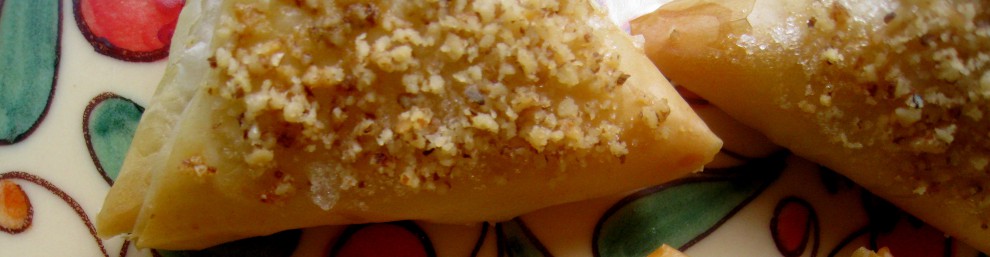
Dulce lo vivas – May you live sweetly!

Dulce lo vivas – la reposteria sefardi by Ana Bensadón (Ediciones Martinez-Roca, Madrid, 2006)

There are many wonderful Sephardic cookbooks – actually written by Sephardim, for a change – that for whatever reason are not available in English. This is a shame, but I suspect that with the growing mania for all things Sephardic, it won’t be long before a publisher or two snap up some rights and get busy translating. They should.

I came across this book one day in the spring of 2006, in a tea salon in Barcelona’s Barri Gotic (Gothic quarter). Small and unassuming, it caught my eye – a straightforward recipe book with no drawings, very few photographs, and the briefest of introductions.  Most of the recipes bore little semblance to the sweets and baked goods I knew from my family’s Ottoman tradition, but there was an approach, a style – delicate, at once elegant and simple – that was undeniably Sephardic. I flipped.
Continue reading

4 Comments

Filed under Other Reading, Recipes

Guëvos Haminados / Huevos Jaminados (Glosario)

Hay un articulo nuevo hoy en el glosario castellano, sobre los “huevos jaminados”.  Se lo encuentra aquí.

Leave a comment

Filed under Escrito en castellano, Glossary, History, Holidays (fiestas judias)

The glossary is back / Ha vuelto el glosario

My small-but-growing Sephardic food glossary is back online; there’s a link in the righthand column (or you can click here).  You can still find any related articles I’ve written here on the blog (and slowly but surely I’ll put cross-referenced links on all the various entries). 

*************************

Mi pequeño-pero-creciendo glosario de comida sefardí esta’ online de nuevo; hay un hyperlink a la derecha (o puedes cliquear aqui).  Todavía se encuentra aquí en el blog articulos relacionados que he escrito.  Y empiezo 0 – finalmente! – a traducir todo en castellano.

Leave a comment

Filed under Escrito en castellano, Glossary

Ajada (Q & A and a recipe)

Hi Janet,

My mother used to make what we called Ajada. It was made with soaked bread, eggs, fresh garlic and lemon juice. It was mixed and mashed together and we used it as a dip for meat. What is the origin of this food?   Is it Turkish or Spanish or Greek?  I would love a recipe if one is available.  Did I ask this question before?  Thanks and wish I could come and take a class with you.

Estelle

Good question, Estelle.

Ajada, a traditional Sephardic condiment, has its roots right here where I live in the north western Mediterranean and is just one member of a broad category of emulsions that are used at table to flavor savory meals – meats, fish, soups, stews, vegetables, you name it.  The word ajada is Ladino and translates loosely as ‘a thing made of/with garlic’ which, along with olive oil, is the basic recipe for the whole category.  Between Catalan, Spanish, French, Langue d’Òc, Italian and umpteen different dialects of each, garlic & oil emulsion goes by at least a dozen different spellings, among them alioli, aioli, alhòli, alloli, ajjoli, aillade, and ajada. The French word in the group, aillade, is equivalent in structure to the Ladino ajada.  The others you see here are all compound words, in various Romance languages, that mean garlic (allium – of the onion family) and oil (oleum).   And with this many variations in the spelling alone, you can easily imagine the countless variations in the recipe – Continue reading

14 Comments

Filed under Glossary, Recipes, Your Questions Answered