Tag Archives: Passover

Ashkenazi Mina, Anyone?

Dear Janet,

My grandparents Nissim, and Virginia, originally came from Istanbul, and the area in Bulgaria just over the Turkish border. I grew up eating borekas, spinach pies, haviar (tarama), biscochos, et al. But there is one dish my grandmother made that although I’ve researched everywhere haven’t found anything remotely similar. Unfortunately no one’s left alive who can even remember what it was called. The ingredients were ground liver, raw eggs, chopped walnuts, rye bread, and possibly chopped onions/celery. The raw ingredients were combined making a paste, which was then spread into a greased baking pan about 1/2 an inch thick, the top glazed with beaten egg, and baked. When cut and served it was quite firm, and dark brown on top. Have you ever heard of anything similar?

Thanks so much for all your hard work, it’s been an enjoyable read.

Alan

Wow.  When we talk about Jewish cooking being adaptive, I suspect this may be a prime – and very personal – example.  Off the top of my head, this sounds like a Sephardic rendition of a classic Ashkenazi dish from Eastern Europe:  chopped chicken liver.  Neither rye bread nor chopped chicken liver are part of Sephardic gastronomy.  Continue reading
5 Comments

Filed under History, Holidays (fiestas judias), Your Questions Answered

Mina


MINA (“MI-nä”) is an Ottoman Sephardic savory pie made from ground beef, onion and spring herbs, bound with eggs and sandwiched between layers of matza (moistened, of course).  In my experience it is a specialty of Rhodes, where it is a star of the Passover repertoire.  However, it is nearly identical to Algerian Sephardic méguena in all except its use of matza, which the Algerian recipe dispenses with altogether in the versions I am familiar with. (Algeria was part of the Ottoman Empire from 1536 to 1830 and had a substantial Jewish community).

There are vegetable minas as well; however, mina is not simply another kind of cuajado.  A true mina contains no cheese, and eggs serve to bind the filling without dominating its appearance or texture. 

As with mustachudos, mina offers another fine example of how symbolism is incorporated into Sephardic recipes, in this case repeating elements of the Seder plate: parsley and eggs to represent springtime and renewal and matza, of course, the unleavened bread of the Exodus that is eaten throughout the week-long holiday.  Mina is served cut in large squares, which bring to my mind the bricks of the Egyptian pyramids – in shape only, as a well-made mina is delicate, moist and intoxicatingly delicious!


Leave a comment

Filed under Glossary, Holidays (fiestas judias)

Mustachudos

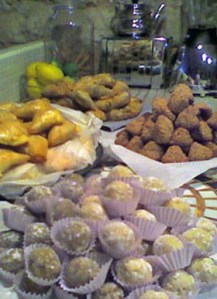
masapan_-ojaldres_-mustachudos1MUSTACHUDOS  (“mōō-stä-CHŌŌ-thōs”)  Here is a prime example of the way in which many Sephardic foods are infused with symbolism.

As a general rule, Sephardic custom doesn’t call much for cooking with wine. There are exceptions, of course, and these can be unusual enough as to impact the name of the recipe in question.  During Passover, any wine consumed must be ‘new’; this means using either grape juice or young wine that is kosher for Passover.  The mustachudo gets its name from this specific ingredient:  musto in Ladino; mosto in Spanish and Italian, must in English. The name has absolutely nothing to do with ‘little moustaches’, despite the similar-sounding root word. Continue reading

2 Comments

Filed under Glossary, Holidays (fiestas judias)