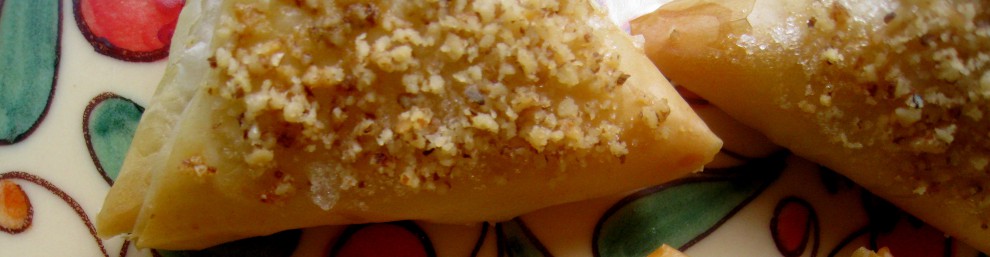
To everything there is a season, and a reason. Sephardic custom – all Spanish custom – is to finish everyday meals with a very simple but specific category of desserts: things soft, light, sweet and simple. It’s the time for puddings, custards, flans and simple fruit dishes, cold in summer, warm in winter. Cakes and more elaborate desserts – and lots of them! – are for festive occasions. This was certainly the norm in our house, and I suppose it served us well by establishing sound eating habits with room for the occasional exercise in outrageous excess (When we were growing up, large and lavish birthday or holiday meals were immediately followed by a second meal, equally large and lavish, called dessert). Continue reading
Tag Archives: Ottoman
Ouevos Haminados
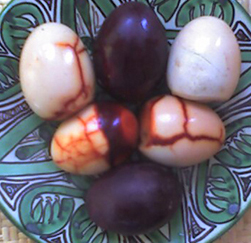 GUEVOS HAMINADOS (“GWEH-vos hä-mi-NÄ–thos”) – The word ham in hebrew means “warm”; haminado is a Ladino adjective meaning “warmed.” Far from ordinary, these “warmed eggs” acquire a velvety texture and an intoxicating, smoky onion flavor from a six-hour bath in warm water and onion skins – slow cooking really does make a difference. Besides lending their marvelous flavor, onion skins also act as a natural dye. If the eggshells remain intact, the eggs turn a delicate shade of light brown, like a very pale cup of coffee, and when cracked they take on a striking range of deep reds and unique patterns that suggest marble. It’s a fairly safe bet that the inspiration for dyed Easter eggs began with this custom.
Guevos haminados are one of many Jewish foods that pre-date the Inquisition. Although eggs were commonplace in all cuisines of Medieval Europe, it was well known in Spain that slow-braising whole eggs was a technique unique to the Jews. More than a few conversos were imprisoned or sentenced to death on the basis of their having continued to eat ouevos haminados. 500 years after the expulsion, eggs in general remain an important component of the Ottoman-Sephardic diet (and, I should add, the Spanish diet as well).
Guevos haminados are generally most associated with the Sabbath desayuno (breakfast) and with Passover, when they appear on the Seder plate, but they are a fundamental element of Ottoman-Sephardic cuisine, eaten on their own or incorporated into other dishes – for example, baked into a meatloaf (without the shell, of course).
Filed under Glossary, History, Holidays (fiestas judias)
Dondurma: Turkish orchid ice cream / Helado turco de orquideas (Q & A)
My mother used to refer to an ice cream she called Dondurma. Are you familiar with this? Have you ever made it. Once, when I was a small child my mother took me somewhere in Brooklyn to eat some and it was divine. My mother was from Monastir, now known as Bitol. Our food were greatly influenced by the Turkish. — healthgal
Well, healthgal, this is a good example of a food that isn’t Sephardic per se but which, as a Turkish delicacy, was – is – consumed by Sephardim along with everyone else in that part of the world. Your mother’s city was within the Ottoman Empire, thus the Turkish influence on her food. Manastir, today called Bitola, is a city in southern Macedonia that lies roughly mid-way between Puglia (the southeastern spur of Italy) and Salonika.
Dondurma (don-DŌŌR-mä), is simply the Turkish word for ice cream, although the similarity pretty much ends there. Elastic, dense and slow to melt, dondurma is made from a mixture of milk, mastic resin and salep. Mastic is an ancient Mediterranean evergreen in the pistachio family and salep is a flour made from Turkish wild orchid tubers of the same name. Salep Dondurma – orchid ice cream – is only about 300 years old; the conventional wisdom is that it was invented in a part of southeastern Turkey where all three key ingredients were plentiful. Dondurma is made by beating the ingredients into a smooth, elastic mass using a long metal rod. Fresh dondurma is draped on large hooks and dense enough to eat with a knife and fork. It is eaten cold, but not frozen. Unlike other ice creams, if allowed to freeze it turns rock hard and brittle. Today, it is impossible to make dondurma outside of Turkey; mass production has so seriously depeleted Turkey’s supply of wild orchids that there’s a government ban on their exportation.
While investigating dondurma it struck me that the texture, if not the temperature, might be reminiscent of Bonomo’s Turkish Taffy, a favorite candy of my childhood. Lo and behold, the Bonomo Candy Company was founded in Coney Island in 1897 by one Albert J. Bonomo (Benhamou, I presume), a Sephardic immigrant from Turkey. Apparently, the Bonomos of Brooklyn loved dondurma as much as your mother did, or at the very least understood its appeal; it was Albert’s son, Victor, who invented “Turkish Taffy” in the 1940’s. How do you like that.
Filed under History, Your Questions Answered
Ojaldres (glossary)
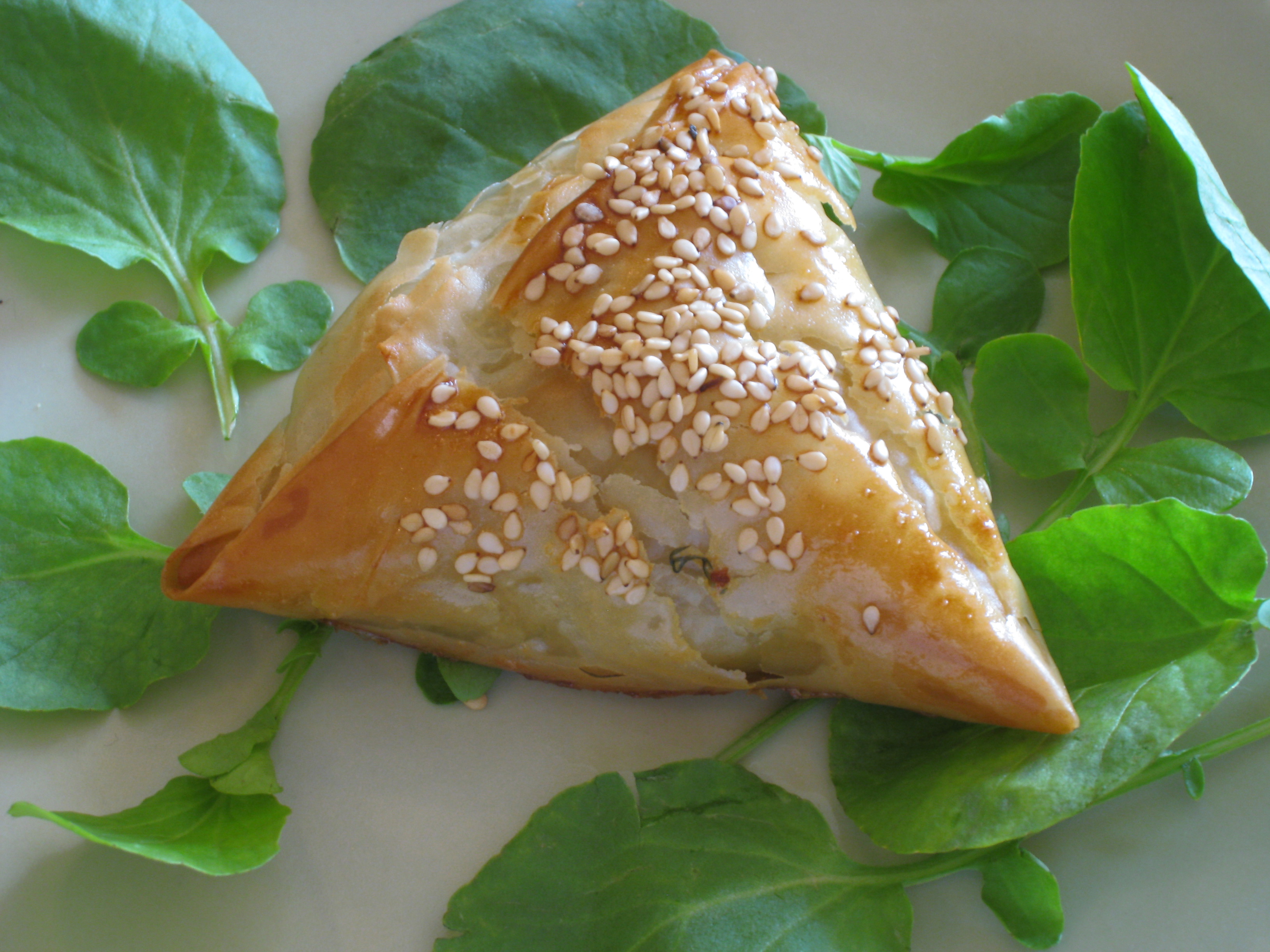
Ojaldre, the Ottoman-Sephardic savory pastry par excellence. © Janet Amateau.
OJALDRES (“ōō- ZHÄL-dres”) – A specialty in the Ottoman-Sephardic tradition and particularly in Rhodes, these are small, triangular-shaped, savory pastries of a few layers of phyllo dough filled either with cheese and potato or ground beef and fresh herbs. To make ojaldres is a labor of love and we generally reserve them for special occasions other than the major holidays, which have so many specific traditional foods associated with them.
Hoja (oja in Ladino) and phyllo are the Spanish and Greek words, respectively, for leaf. As with the French mille feuilles (‘1,000 leaves,’ which in America is called a Napoleon), both describe the distinctive characteristics of the pastry dough itself.
In modern Spanish, hojaldre (“ō–HÄL-dre”) is the word for puff pastry. We tend to think of puff pastry as French, but the dough originated in Spain, where traditional bakeries make rustic puff pastries and cookies as they have for centuries. It’s also common to see the word applied to all variety of small sweet commericial cakes and cupcakes (think Hostess, Drake’s, Little Debbie).
Filed under Glossary

 SEPHARDIC FOOD