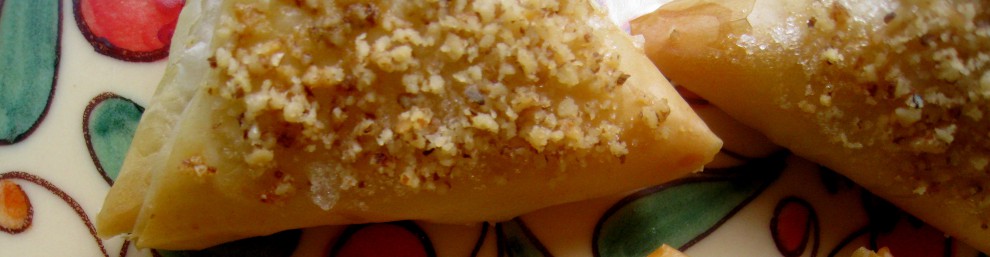
To everything there is a season, and a reason. Sephardic custom – all Spanish custom – is to finish everyday meals with a very simple but specific category of desserts: things soft, light, sweet and simple. It’s the time for puddings, custards, flans and simple fruit dishes, cold in summer, warm in winter. Cakes and more elaborate desserts – and lots of them! – are for festive occasions. This was certainly the norm in our house, and I suppose it served us well by establishing sound eating habits with room for the occasional exercise in outrageous excess (When we were growing up, large and lavish birthday or holiday meals were immediately followed by a second meal, equally large and lavish, called dessert). Continue reading
Is it Sephardic enough?
Is it really Sephardic? Is it Sephardic enough?
Ethnic food is born and evolves out of common cultural experience and worldview. There’s no law against creating your own modern Sephardic recipes and no need to think you can’t do a riff on someone else’s version of a traditional one, either. We can be become so obsessed with preserving our culture that we tend to deny ourselves permission to experiment, or to accept someone else’s interpretation of something as valid, even if they’re from within the same culture. This holds true for any people (but probably with a higher level of anxiety when they’re propagandized as being extinct!). But it’s openness and experimentation that keep all cultures alive and interesting, and that can also get things back on track if they’ve lost their connection to a basic principle. If you do lose touch with the fundamentals of your own culinary heritage, if you start using too many shortcuts and too many substitutions, you deviate so far from your roots that you’re left not so much with a pale imitation of the real article as with something virtually unrecognizable. Continue reading
Filed under General
Ouevos Haminados
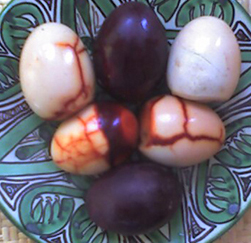 GUEVOS HAMINADOS (“GWEH-vos hä-mi-NÄ–thos”) – The word ham in hebrew means “warm”; haminado is a Ladino adjective meaning “warmed.” Far from ordinary, these “warmed eggs” acquire a velvety texture and an intoxicating, smoky onion flavor from a six-hour bath in warm water and onion skins – slow cooking really does make a difference. Besides lending their marvelous flavor, onion skins also act as a natural dye. If the eggshells remain intact, the eggs turn a delicate shade of light brown, like a very pale cup of coffee, and when cracked they take on a striking range of deep reds and unique patterns that suggest marble. It’s a fairly safe bet that the inspiration for dyed Easter eggs began with this custom.
Guevos haminados are one of many Jewish foods that pre-date the Inquisition. Although eggs were commonplace in all cuisines of Medieval Europe, it was well known in Spain that slow-braising whole eggs was a technique unique to the Jews. More than a few conversos were imprisoned or sentenced to death on the basis of their having continued to eat ouevos haminados. 500 years after the expulsion, eggs in general remain an important component of the Ottoman-Sephardic diet (and, I should add, the Spanish diet as well).
Guevos haminados are generally most associated with the Sabbath desayuno (breakfast) and with Passover, when they appear on the Seder plate, but they are a fundamental element of Ottoman-Sephardic cuisine, eaten on their own or incorporated into other dishes – for example, baked into a meatloaf (without the shell, of course).
Filed under Glossary, History, Holidays (fiestas judias)
Candied Baby Eggplant / Berenjenitas en Dulce
Dear Janet,
In Morrocco, 50s and 60s, I used to eat a Sefardi dessert I never found in any kosher or Sefardi cookery book… small aubergines or berenjenas en dulce. Maybe with honey or syrup. La Senora Amalia was keeping this recipe for her family… So delicious! Thank you — Mary, UK
Cooked sweets – purees, compotes, marmalades, pastes, hard candies and whole preserves – are a very important component of Sephardic culinary traditions and social customs. Whole fresh and dried fruits, citrus peel, flower petals, seeds, nuts and even vegetables are transformed into sweets of various forms, textures, colors and flavors, to be served, with tea or coffee and perhaps a little pomp, when company comes. My own grandparents and great grandparents, from Rhodes & Adalia, favored sweets made from quince, almonds, apricots, prunes, figs, tangerine peels, rose petals, apples, dates and sesame. There are also recipes for lemons, grapefruit, pears, sour cherries, grapes, tomatoes, pumpkin and, in Moroccan tradition, eggplant (in case you’re wondering, eggplant is actually a fruit). The list goes on.
Here is one of two candied eggplant recipes from “Dulce lo vivas,” a beautiful collection of Moroccan Sephardic desserts by Ana Bensadon that I will write about this month. The book is only available in Spanish; the translation below is mine. The departures here from Ottoman-style fruit preserves are the very lengthy cooking time and the combination of spices. Traditional Ottoman fruit preserves call for milder flavorings – at most only one of the spices used here, plus rose or orange flower water or, as my dad would say, a little lemon juice.
Filed under Recipes, Your Questions Answered

 SEPHARDIC FOOD