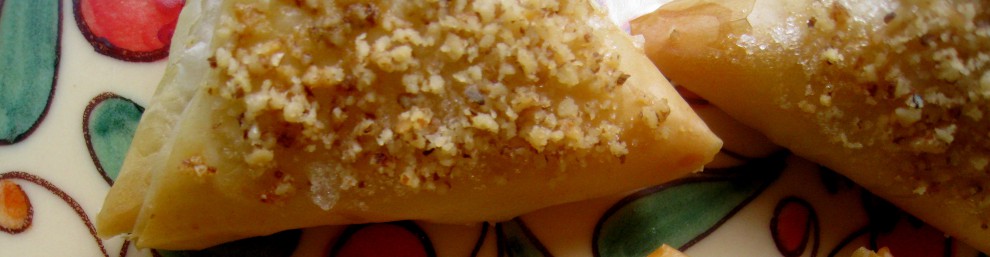
Palamida: Fish preserved in salt

This post is for Kathy, who asked how to make Greek style preserved salted fish. In Spain, as in Greece, this is a classic appetizer.

Palamida is the Greek name of bonito, a small fish in the tuna family. In Sephardic kitchens (or at least in those of the Rhodesli), that’s the only name given to the salt-cured dish made from it. Reader Ino Alvo recalls the word soymas from the Salonican Jewish community.  I have yet to figure out the etymology of the word – probably Ladino – though it is at least partially based in Greek. The Spanish name for the same dish is mojama, which derives from mujaffifa (or something similar), an Arabic word meaning dehydrated. Language lesson over.

Curing, or “cooking” fish in salt is an ancient and universal preservation technique, used by the Vikings as much as by the ancient Greeks and Phoenicians – both of whom had trade colonies in Iberia thousands of years before the Arabs arrived.

If salting fish was commonly practiced among coastal peoples, it was the Portuguese who established Atlantic salt cod as a staple food throughout Europe beginning in the 1500’s (by that time the Portuguese traders were mostly conversos).

Let’s get back to the fish itself. The longer you leave fish – or anything – in salt, Continue reading
15 Comments

Filed under History

L’shanah Tova!

Happy New Year to one and all!

3 Comments

Filed under Holidays (fiestas judias)

Q&A: Bread vs. Rice

Dear Janet:

In my father-in-law’s family they always served rice instead of Challah for Shabbat. Is that an Izmir tradition? Victor thinks it is Sephardic; however, I’ve been to other Sephardic homes that I believed had Challah. I’ve tried to look up the history but have hit an end. I’d love it if you could assist. Thank you in advance. – Lael Hazan

Victor is partially right, Lael. Challah per se – the braided loaf – is not a Sephardic tradition, and as one of the most elemental staples of the Sephardic diet, rice is served on Shabbat as on most other days. If a Sephardic cook were to choose one over the other to serve the family, the choice would be a rice pilaf of some sort; the bread is the extra. We don’t think of rice as a bread substitute, nor vice versa.

That said, festive breads have a distinct place on the Sephardic table, Continue reading

2 Comments

Filed under History, Your Questions Answered

Q&A: Sodra, a Micro-regional Passover Dish Sub-par Excellence (but not without its dignity)

Sodra is broken-up matza soaked in chicken broth, with eggs and lemon added to the mix in typical Sephardic fashion, maybe dressed with some cheese or a little garlic. It’s an obscure dish, even among Sephardim, included in a couple of Sephardic cookbooks but ignored by most, and not without reason. Don’t be offended, sodra lovers; read on.

Because it’s a traditional dish I see a reason to honor it as a piece of Sephardic heritage, but to be blunt, sodra is just mush. Pablum. Pap. A holiday dish made by people who were either desperately poor, or desperately lacking in culinary skill and imagination, which is the far less likely of the two possibilities.

While there’s no shame in poverty, I see no reason to glorify it or its byproducts, either. Poverty stinks. Going hungry seriously stinks. And certain habits are better left behind when they’ve outlived their necessity. Like prison food. Or Ramen noodles. Continue reading

13 Comments

Filed under History, Holidays (fiestas judias), Your Questions Answered