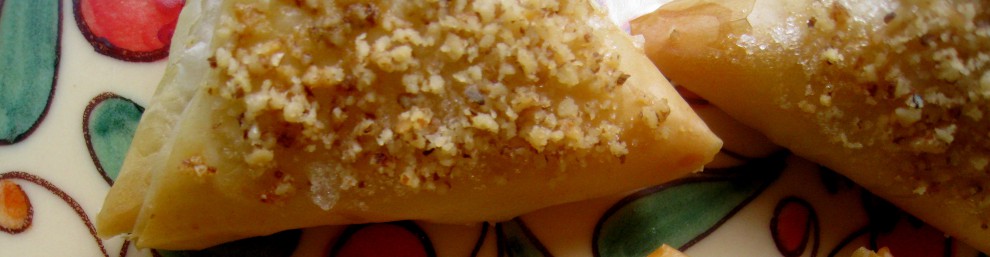
Boyos / Bollos (glossary)

Okay, this is it.  I’ve revised the glossary entry based on my new and improved understanding of boyos.  This replaces my post of January 7, which you won’t find any more.

BOYO (BOY-ōō) is the Ladino word for bun – spelled bollo in modern Spanish.  In Sephardic cookery it is a generic term applied to a broad range of savory & sweet baked goods, be they doughy, crunchy, chewy, flaky and so forth.  Some examples include boyos de vino (biscocho cookies made with wine); boyos de rayo (flaky cheese biscuits) and just plain boyos, which are savory pastries filled with spinach, or cheese, or spinach & cheese (yes, there are more kinds of boyos). 

Boyiko is the diminutive of boyo.  The literal translation is ‘small boyo’, but it can just as easily imply ‘without filling.’  Either way it signifies an abbreviated form of boyo.

It’s the use of the word ‘bun’ that has intrigued me, since cookies (boyos de vino) and biscuits (boyos de rayo) are not buns, obviously.  To understand why these, too, would fall under the bun category, I looked to the word itself and to technique for an explanation.  And therein lay the answer.

All of these wildly different boyos share a specific technique when made according to tradition.  After a pastry is first either folded and filled or rolled into a small ball, it is then mashed down lightly with the heel of the hand prior to baking, forming a small cavity or dent.  It is the dent itself that turns out to be the origin of the pastry name, as the word ‘bollo’ has a second meaning:  dent.  In Spain today (if not elsewhere in the Spanish-speaking world), this usage is more colloquial, having been replaced by the more lofty-sounding ‘abollatura’.

The dent serves a purpose.  In the case of non-filled boyos or boyikos, it is a quick and effective means of making a reasonably flat cookie without a rolling pin, and in the case of filled boyos, pressing the dough seals the pastry shut.  It’s that simple.  You want to make boyos of any kind?  Flatten them with your hand before you bake them.  I’m retiring my rolling pin.

My thanks to Michael, Zoe and my Aunt Rady, whose recollections of hand-pressing the dough of three radically different pastries helped me get to the bottom of boyos! There’s much, much more to say on the subject, but I’ll leave that for another day.

You have no idea how much I love this work.
11 Comments

Filed under Glossary

What an Ethnic Cookbook Should Be

Great ethnic cookbooks are as much about culture as they are about good recipes.  To my mind, the best of them include personal memoirs and family histories, placing authentic recipes and styles of cooking in specific cultural and historical context.  Today I offer a prime example.

The Classic Cuisine of the Italian Jews by Edda Servi Machlin (Dodd Mead, New York 1981/republished by Harper Collins 2005).

A few years ago my then 91-year-old great aunt Esther gave me this book from her collection.  “Is it any good?” I asked her.  “Eh,” she said, with a dismissive shrug, “I won’t miss it.”  Well, no wonder.  Aunt Esther is a very competetive cook and this book is fantastic.

Pitigliano is a small, remote village in southern Tuscany, roughly halfway between Rome and Florence.  The Jewish community there was as unique in Italy as that of Rhodes was in the Ottoman Empire, with a history dating back to ancient Roman times.   Also like the Jewish community of Rhodes, Pitigliano’s, too, was decimated in World War II.  To our great good fortune, Mrs. Machlin grew up there and saved what she was able, recording these classic Tuscan- and Roman-Jewish recipes and offering a detailed memoir of life in a close-knit, Italian-Jewish community of the early 20th century.  Her recipes are delicious and she writes in loving and authoritative detail.

Remember, this is not a Sephardic cookbook.  Judeo-Italian food is Italian food (I’m not complaining!).  For those interested, however, here and there it does reflect Sephardic influences that reached Italy both directly from Spain and through contact with the Ottoman Empire.  Mrs. Machlin recognizes this influence and acknowledges it.

It would be hard not to appreciate this book.  It’s a gem.

2 Comments

Filed under History, Other Reading, Recipes

More on Boyos: a revised conclusion / Mas Sobre Boyos

Your participation is not only encouraging but proving to be very, very helpful; it is our collective personal experience that leads me toward what I believe are the right conclusions for so many unanswered questions about Sephardic food. 

Recently, for example, I’ve been wondering why there are so many variations of boyos that, apart from the name ‘boyo’,  seem to bear no resemblance whatsoever to one another.   Why on Earth would cookies and biscuits  be categorized as buns (which is what ‘boyo’ means)?   I did draw one conclusion, based on how recipes evolve, which I included in the glossary (read that post here).  But that conclusion, for all its logic, didn’t quite satisfy me.  Thanks to your participation, I now know why:  The common denominator is one of technique.  Continue reading

12 Comments

Filed under Glossary

About all those “Sephardic” cookbooks out there…

Any serious writer will tell you:  the first rule of good writing is to write about what you know.  Well.  In my experience and in the experience of several of my readers, for all the Sephardic cookbooks that are out there, it’s hard to find one with recipes that are both good AND authentic.  The same can be said for much of the historical and cultural commentary in many of these same books, most of which were not written by Sephardim and whose authors have relied on secondary and tertiary sources for their “authoritative” information.  Or they’ve just made assumptions and offered those up as fact.  In a world that is well populated by Sephardim – who are easy to find, generally eager to share their knowledge and experience (not just their recipes) and to learn the same from one another – I find this at best a little misguided, at worst, offensive.

Of the many Sephardic cookbooks I’ve read to date, there are few I can recommend (that’s really why I began this project in the first place).  Here’s a little sampling of what’s out there:   For starters, one author cooks meat with butter.  Another admits to knowing nothing about cooking – let alone Sephardic cooking – and invents recipes that do a fine job of demonstrating his ignorance.  Another, clearly impatient and bored with her subject matter, dismisses just about every recipe in her book and doctors some with touches that would make a Sefardi gag.   Another over-explains Sephardic humor (excruciatingly), over-elaborates recipes (incorrectly), and makes woefully inaccurate blanket assertions about “all” Sephardic Jews (arrogantly).  And each of these authors writes of the Sephardim as if we were all dead and gone. 

If you’re not already dumbstruck, two of these examples come from award-winning books.

It is this very lack – of intimate knowledge of the Sephardic experience,  of an interest in meaningful contact with the Sephardic community,  of mindful curiosity and a geuine desire to tell an honest story – that leaves these (I would like to think) well-intentioned writers unprepared or unwilling or unable to ask the right questions or offer up the real McCoy.  So, either their research falls short, or their “traditional” recipes are nothing of the kind, or their interpretation of Sephardic culture is abominable.

That said, there are dozens of books I have yet to read, many of which I hope will be good and others that I’m certain are great.  Time, lousy eyesight and a woefully inadequate local post office make it very slow going.  Soon I’ll write here about a few books I already know and find exemplary for one reason or another.  I will add more as time and good taste permit.

10 Comments

Filed under Other Reading